
As we enter the first quarter of 2026, investors are balancing a resilient U.S. economy, shifting interest-rate expectations, and a market narrative still dominated by artificial intelligence and mega-cap technology. Each quarter, Blue Chip Partners steps back from the headlines to evaluate what the data—and market history—may be signaling for the months ahead.

The Economy: Growth Expectations for 2026 (With Less Clarity Than Usual)
The fourth quarter of 2025 was unusual in one important way: reliable economic data was harder to come by. The government shutdown affected the availability of key indicators—labor, inflation, and other datasets—making it more challenging to build a complete, real-time picture of economic conditions.
Even so, U.S. growth in 2025 surprised many investors. The most recently available figures showed strong momentum earlier in the year, with GDP growth near 4% in the second quarter. While tariff-related distortions created “noise” in some data points, several supportive themes have remained intact heading into 2026:
- AI-related investment is increasingly showing up in real economic activity (not just speculation)
- Financial conditions have eased as interest rates moved lower
- Tariff drag may diminish as the calendar turns and prior impacts are lapped
The two areas likely to matter most for policymakers and markets in early 2026 remain the same: labor and inflation.
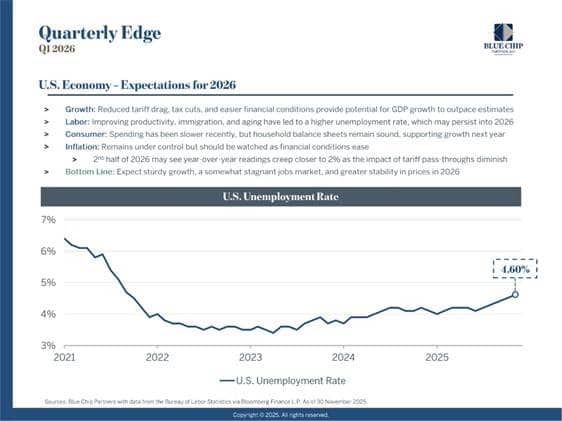
Labor and Inflation: The Fed’s Tightrope in 2026
The Federal Reserve’s shift toward easier policy appears to be driven by softening labor market conditions. Hiring has slowed relative to prior years, productivity has improved, and unemployment has trended modestly higher. That backdrop suggests an unemployment rate in the high-4% range could be a reasonable expectation as 2026 progresses.
At the same time, the Fed is watching inflation carefully. Lower interest rates can support spending and demand, and policymakers are mindful of easing too quickly if it risks reigniting price pressures. So far, there hasn’t been clear evidence of a renewed inflation surge, but it remains a key variable—especially as more complete data becomes available following late-2025 reporting disruptions.
Bottom line: steady growth, a cooler labor market, and the potential for greater price stability as the year advances.
Equities: Are We in a Stock Market Bubble?
One of the most common questions investors ask today is whether the U.S. equity market—particularly the S&P 500—is in a bubble. From our perspective, the answer is no, but the concern is understandable.
Higher valuation multiples have historically been associated with lower long-term forward returns. Looking at the S&P 500’s forward P/E near ~23x, history-based comparisons can imply muted long-term results if you view valuation in isolation.
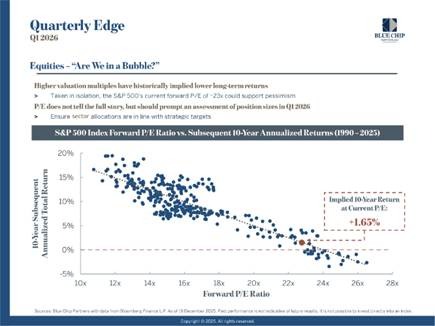
Why P/E Alone Doesn’t Tell the Full Story
Forward P/E uses next-12-month earnings estimates, which is helpful—but it can still miss an important question: what does longer-term earnings growth look like?
A more complete view includes growth expectations, which is where the PEG ratio (P/E divided by estimated long-term earnings growth) can be useful. When viewed through this lens, the S&P 500’s valuation appears closer to historical norms than P/E alone may suggest.
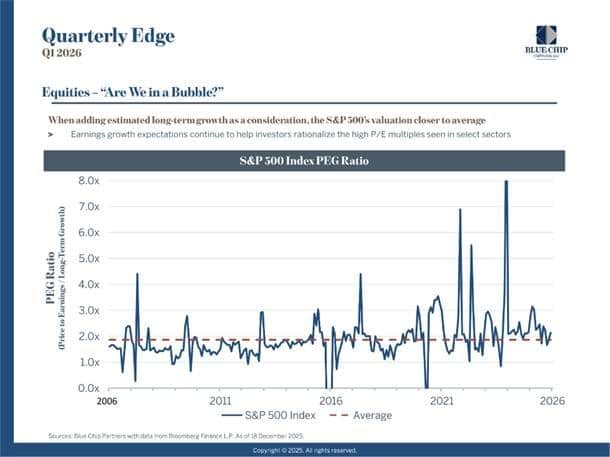
Sector-Level Perspective: What’s Changing Beneath the Headlines
Another important nuance is that earnings growth has been concentrated in the areas of the market that have led performance—particularly parts of technology and adjacent sectors. Unlike the late-1990s tech era, today’s market leaders are generally supported by real earnings, recurring revenue models, and healthy balance sheets.
At the sector level, valuation looks different once growth is incorporated. As shown below, technology has become less extended than many investors assume, particularly on a PEG basis, and its forward P/E has moderated compared with earlier peaks.
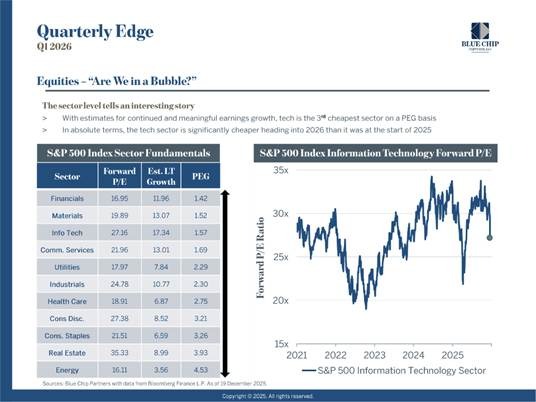
Practical Portfolio Takeaway
Even when the “bubble” label doesn’t fit, discipline still matters. Strong-performing positions can become outsized over time, and markets can shift quickly over shorter windows due to sentiment. Investors may benefit from periodic rebalancing to keep allocations aligned with strategic targets and diversification goals.
A Broader Equity Story: Small Cap and International Momentum
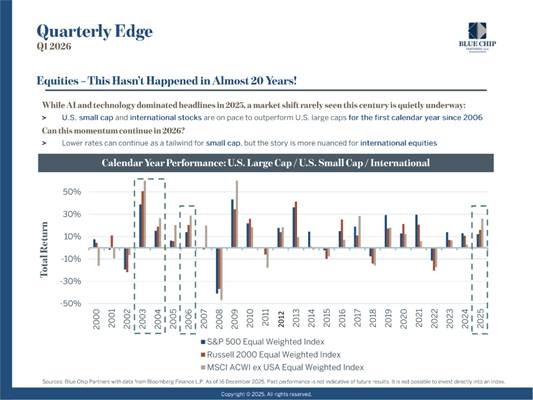
While AI and mega-cap tech dominated headlines in 2025, a broader shift has quietly been underway. For the first time since 2006, U.S. small cap and international equities have been on pace to outperform U.S. large caps on an equal-weighted basis.
Small Caps: The Rate-Cut Playbook
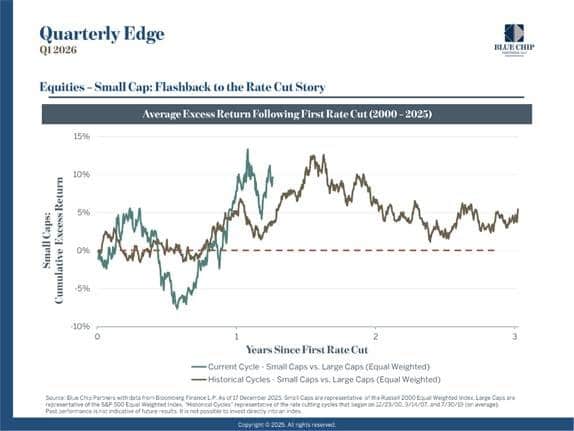
Historically, declining-rate environments have tended to be a tailwind for small-cap stocks relative to large caps. Lower rates can ease interest burdens and improve financial conditions—factors that can disproportionately benefit smaller companies.
The chart below highlights how small caps have often performed in the years following the first rate cut of a cycle.
International Equities: More Nuanced, But Still Interesting
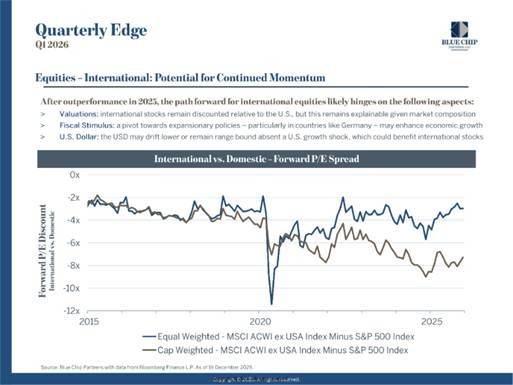
International markets often trade at persistent valuation discounts to the U.S., partly because their market composition is more tilted toward cyclical sectors like financials, materials, and energy. While that discount has narrowed, valuation alone may not be the full thesis.
Other factors that can influence international performance include:
- The U.S. dollar: a weaker dollar has historically aligned with stronger international equity performance
- Policy direction: parts of Europe have shown movement toward more growth-supportive, expansionary policies
- Relative rate paths: Fed easing can coincide with dollar softness, which can matter for international returns
Fixed Income: Value Proposition Remains Intact
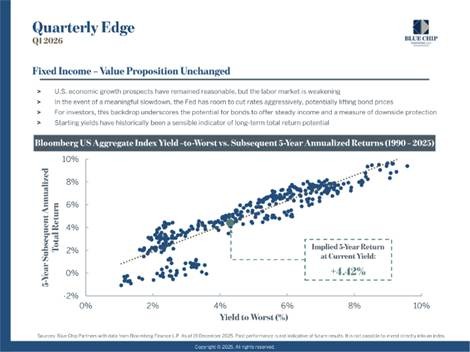
Bonds continue to play a critical role in diversified portfolios—both as a source of income and as a counterbalance during periods of equity volatility. With yields still meaningfully above the levels seen in much of the prior decade, fixed income remains a segment of the market where investors may not need to “reach” for yield to pursue income goals.
Historically, starting yields have been a useful indicator of longer-term total return potential in core bond allocations. And in a declining-rate environment, bond prices and yields move in opposite directions—meaning the interest-rate backdrop can become a tailwind for bond returns, even if the path is not perfectly smooth.
Key Takeaways for a Q1 2026 Investment Outlook
As we move into the early months of 2026, several themes stand out:
- The U.S. economy has remained resilient, though late-2025 data disruptions complicate near-term visibility
- Equity valuations look different when growth expectations are considered—not just P/E in isolation
- Market participation has broadened beyond mega-cap U.S. stocks, with small cap and international strength emerging
- Bonds continue to offer income potential and diversification support in portfolios
If you’d like to discuss how these themes relate to your allocation and risk profile, our team is here to help.
Watch the full discussion here: https://youtu.be/twsKOpbrZfY
Disclaimer: Individual views and opinions expressed in the podcast, article, or other media included herein may not necessarily reflect the views and opinions of Blue Chip Partners, LLC. This material has been prepared for informational purposes only and is not intended to provide and should not be relied on for individualized financial, tax, legal or accounting advice. You should consult your own professional financial, tax, legal, accounting, or equivalent professional prior to making any investment decision. All investments involve a degree of risk, including the risk of loss. Past performance is not indicative of future results.